Sunday, 27 January 2013

Sunday, 2 December 2012
Celestron C6 Hyperstar SPC900NC Orion and Flame Nebulae
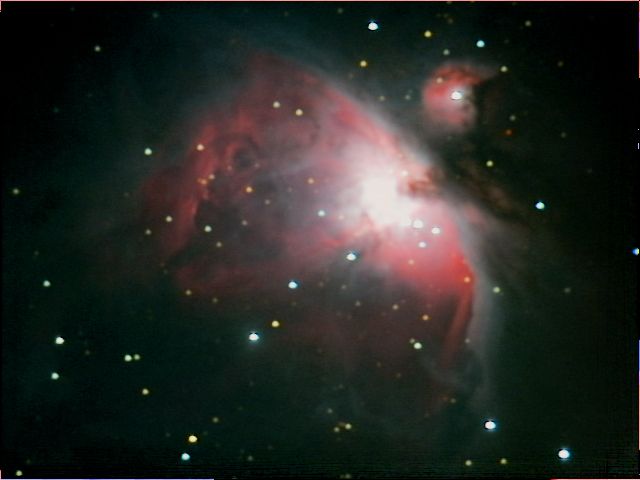
Orion Nebula M42 80x10s 13.3min 9xDark
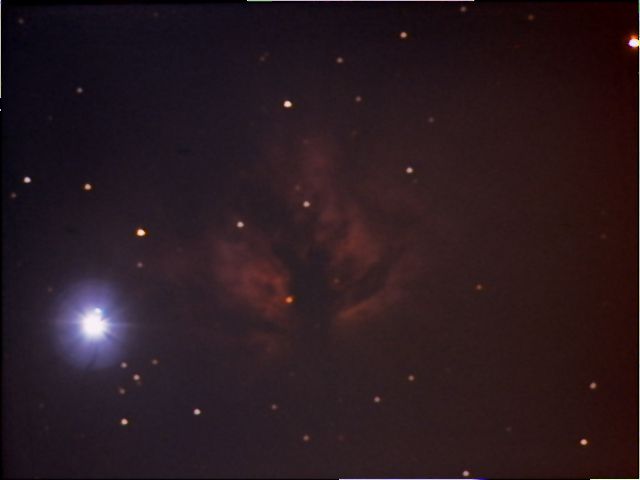
Flame Nebula 135x10s 22.5min No Dark
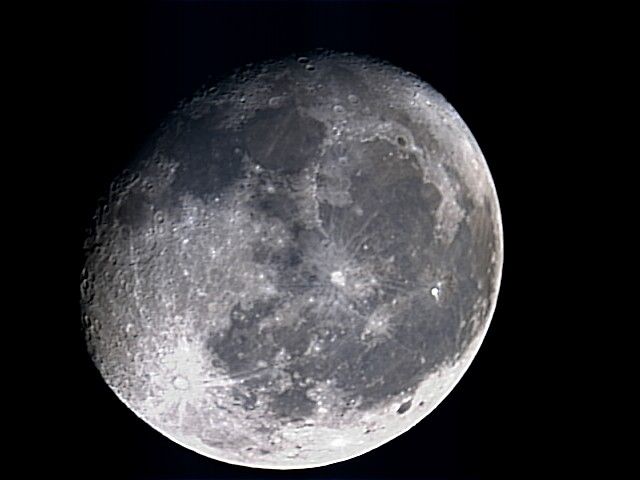
Moon 747 Stacked Frames in Registax
Equipment lists:
Celestron C6 SGT/SCT
Nexstar SLT Mount
Hyperstar Lens FL290mm f1.9
Baader Neodymium Filter
SPC900NC LX/Amp off
Stacked with DSS
It was a very clear night but very cold as well. The moon was 90% illuminated as shown above. The hyperstar collimation was brought to the default position; screwed down all the way back. It seems to be rather acceptably collimated with the default. The moon looks good. The starts in the nebulae photos looks okay as well.
There seems to a problem with the dark frame calibration this time. A total of 29 dark frames from a group of 9 and 20 frames were taken but if all of them were used for calibration, vertical streak would appear on the images. So, only 9 dark frames were used for calibration on Orion Nebula while none for Flame Nebula. Some forum suggested that the streaky image is a result of mismatch dark frames, i.e different temperature between the light and dark frames. This is very much possible as light/dark frame are taken at different time, sometimes at 20-30 minutes apart. Some suggested not to use dark frame. Even without calibration using dark frame, there seems not that much noise after all except for one or two visible hot pixels. The frame capture sequence is as follow, Orion, Dark 9, Orion, Dark 20, Flame.
Saturday, 1 December 2012
Taxi Fare : Hazel Farm, University of Surrey, Guildford Town, Train Station
Hazel Farm to Guildford Cathedral / University of Surrey : £8.40 day time
Guildford Train Station Main Entrance to Hazel Farm : £10.40 after 11PM
Guildford Train Station the Other Entrance to Hazel Farm : £12+ or £11+ (can't remember exactly) after 11PM
The fare after 11PM is about 50% more than before 11PM as told by the taxi driver. Both taxi and private hire car are charging the same fare as the fare is set by the borough council.
Saturday, 24 November 2012
Telescope Arduino Stepper Motor Focuser Current Rating using 28BYJ-48 5V and 12V
The motor focuser is used to control the focusing knob of the Celestron C6 SCT. The controller board is Arduino Nano and the stepper motors is the 5V or 12V versions of 28BYJ48. It seems that the 12V version is using much less current as compared to the 5V version when supplied with 12V. It also should generate less heat.
Current Measurement
Arduino Nano and Driver Board : 40 mA
28BYJ48-5V supplied with 12V (inc arduino nano and driver board)
Max. speed (Delay@750µs) : 380 mA
Min. speed (16000µs) : 510 mA
28BYJ48-12V supplied with 12V (inc arduino nano and driver board)
Max. speed (900µs) : 150 mA
Min speed (>10000µs) : 180 mA
The delay in microsecond as shown in the parentheses refers to the delay when changing the step of the stepper motor. The shorter the delay, the faster the motor will spin. From stall, the maximum stepping rate for the two motors are different and it is faster in the 5V version as shown above. Once the motor is running, the delay can be reduced slightly to achieve faster spinning. As for the 12V version, ~17RPM is achieved with 850µs delay and ~19RPM with 750µs delay.
Nexstar SLT Current Rating Measurement
Measured Current for Nexstar SLT without Load
Idle : 150mA
Altitude slewing only (Rate 9) : 330mA
Azimuth slewing only (Rate 9) : 90mA
Azimuth slewing only (Rate 6) : 30mA
Total current at Rate 9 slewing speed on both axes (Idle+altitude+azimuth): 570mA
Total current when tracking : 190mA
Idle : 150mA
Altitude slewing only (Rate 9) : 330mA
Azimuth slewing only (Rate 9) : 90mA
Azimuth slewing only (Rate 6) : 30mA
Total current at Rate 9 slewing speed on both axes (Idle+altitude+azimuth): 570mA
Total current when tracking : 190mA
The real max. current flow is lower than the 750mA as suggested by the manufacturer. Slewing at lower speed uses less current then faster speed. With Celestron C6 SCT as the load, the azimuth current stays about the same (~10mA increase). When going up and down in the altitude axis, 30mA higher and 20mA lower current are measured, respectively. The telescope is not in perfect balance and this might cause the differences. The difference in the azimuth and altitude current suggest that the motors used are different. The total current when tracking is only 190mA which is not that much. Slewing seems to be eating the battery the most especially in the altitude axis.
Friday, 23 November 2012
UK License (DVLA) Address Change : How Long?
Any changes to the permanent address needs to be informed to DVLA. As a consequence, the plastic photocard and green Counterpart Driving Licence need to be updated as well. On the front page of the green Counterpart Driving Licence , fill in the new address, sign and date at the "Changes to your permanent address, ..." section. Together with the plastic photocard driving licence, send them to DVLA, Swansea, SA99 1BN (That's right. A very short and simple address.). The photo in the database will be used. So, new photo is not need. There is no application fee. According to DVLA D100 booklet on page 8, it is permissible to drive while waiting for the new licence to arrive. If renting a car from Kendall Guildford without the license, bring some other ID such as a passport and they will be able to check with DVLA except on Sunday for a fee of £5.
When I updated my address, the whole process took 14 days including the day it was sent to DVLA and delivered back to me. It was sent using Royal Mail Special Delivery (RMSD) envelope. I also provided them with another prepaid RMSD with self return address and they used it. RMSD is a next day delivery service. It uses different channel and is not mixed with 1st and 2nd class mails.
When I updated my address, the whole process took 14 days including the day it was sent to DVLA and delivered back to me. It was sent using Royal Mail Special Delivery (RMSD) envelope. I also provided them with another prepaid RMSD with self return address and they used it. RMSD is a next day delivery service. It uses different channel and is not mixed with 1st and 2nd class mails.
Thursday, 22 November 2012
University of Surrey WiFi Setting Android
WiFi setting as below:
SID: UOS_SECURE
Security: 802.1x EAP
EAP method: PEAP
Phase-2 authentication: MSCHAPV2
Identity: Surrey username without @
Password: xxx
There are other wifi networks as well in the university: UOS_OPEN, UOS_VISITOR and eduroam.
SID: UOS_SECURE
Security: 802.1x EAP
EAP method: PEAP
Phase-2 authentication: MSCHAPV2
Identity: Surrey username without @
Password: xxx
There are other wifi networks as well in the university: UOS_OPEN, UOS_VISITOR and eduroam.
Subscribe to:
Posts (Atom)